
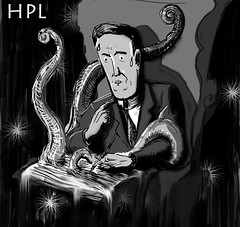
Yet I know very little about him.
Don't get me wrong, I'm not completely ignorant. I've brushed up a bit on old H.P.'s past, as evidenced in the above paragraph. I've read some delightful pastiches, like Sarah Monette and Elizabeth Bear's "Mongoose" and Samantha Henderson's "Maybe the Stars." I've even picked up a few of Lovecraft's original tales, most notably "The Call of Cthulhu." Yet I can't claim any sort of comprehensive knowledge about the author or his work.
Well, I want to change that. In 2012, I'm going to give myself an eldritch education.
Here's how it will work: Over the next twelve months, I plan to read each and every piece of fiction that Lovecraft himself wrote. Note that this excludes several stories in which uncredited collaborators had a hand. To guide me, I've chosen the S.T. Joshi-edited anthologies The Call of Cthulhu and Other Weird Stories, The Thing on the Doorstep and Other Weird Stories and The Dreams in the Witch House and Other Weird Stories. Every two weeks, I'll post my reviews of recently read tales, providing a plot synopsis, a sample of Lovecraft's inimitable prose, and my oh-so-humble opinion about each story's scariness (ranked on a scale of 1 to 5 sanity-shredding shoggoths, which the talented Ollwen Jones has winningly illustrated).
Ready to go? Good. Let's dive into some forbidden knowledge ...
• "Dagon" (A morphine-addled sailor pens a memoir detailing why he can no longer continue living.)(Picture: CC 2008 by ChrisCosco)
• "The Statement of Randolph Carter" (Carter must explain to authorities how and why Harley Warren disappeared.)
• "Facts Concerning the Late Arthur Jermyn and His Family" (Why exactly did Sir Arthur Jermyn set himself ablaze one evening on the dark moor?)
• "Celephaїs" (The man hadn't always been called Kuranes.)
• "Nyarlathotep" (When Nyarlathotep was made manifest, the seasons themselves seemed sundered from their usual patterns and the nations were shaken by unnamed apprehensions.)
• "The Picture in the House" (Can any eerie setting match the horror of those mouldering New England cottages?)
• "The Outsider" (The narrator can scarcely remember anything about his early life apart from the castle.)
• "Herbert West -- Reanimator" (Herbert West was anything but an ordinary doctor.)
• "The Hound" (The pair could hardly have anticipated the trouble that the amulet would bring them.)
• "The Rats in the Walls" (Only the narrator and his feline can hear the rodents scampering between plaster and stone.)
• "The Festival" (Even though it was Christmas, the crowd hadn't gathered to celebrate Messiah's advent.) • "He" (The city, which should've brought wonder and delight, had become a place of psychic oppression.)
• "Cool Air" ("You ask me to explain why I am afraid of a draught of cool air.")
• "The Call of Cthulhu" (The madness seemed to have begun on March 22, 1925.)
• "The Colour Out of Space" (For Nahum Gardner, the terror began when the meteorite fell.)
• "The Shadow Over Innsmouth" (They call it The Innsmouth Look ...)
• "The Whisperer in Darkness" (Miskatonic University professor Albert Wilmarth always considered himself a skeptic.)
• "The Haunter of the Dark" (Everyone agrees that Robert Blake must've died from natural causes.)
• "The Tomb" (Jervas Dudley knows he might be insane.)
• "Beyond the Wall of Sleep" (When Joe Slater would awaken, he'd scream a great, taunting being who sought to torment him.)
• "The White Ship" (Basil Elton, keeper of the North Point lighthouse, loved the sea in all its mystery.)
• "The Temple" (Karl Heinrich, Graf von Altberg-Ehrenstein, Lieutenant-Commander in the German Navy, discovered something terrible as his U-29 plunged to its doom.)
• "The Quest of Iranon" (The youth named Iranon has always sought the same thing -- Aira, distant golden city of all beauty.)
• "The Music of Erich Zann" (Paris must contain the Rue d’Auseil somewhere among its myriad streets.)
• "Under the Pyramids" (Harry Houdini has found himself in some tough scrapes over the years.)
• "Pickman's Model" (No one would deny Richard Upton Pickman's artistic brilliance -- or his perversity.)
• "The Case of Charles Dexter Ward" (Charles Dexter Ward's odd studies have wrought a terrible change in him.)
• "The Dunwich Horror" (Few outsiders come to Dunwich any more.)
• "At the Mountains of Madness" (Dr. William Dyer has found something more than geological specimens beneath the arctic ice.)
• "The Thing on the Doorstep" (Daniel Upton shot his close friend Edward Derby in the face.)
• "Polaris" (Cloudless nights bring on the memories.)
• "The Doom that Came to Sarnath" (In the land of Mnar, there was lake, and around that lake there was a city named Ib.)
• "The Terrible Old Man" (The Terrible Old Man pays for all his goods with coins minted two-centuries ago.)
• "The Tree" (In the midst of its sylvan beauty, Mount Maenalus bears a single odd feature: a monstrous olive tree.)
• "The Cats of Ulthar" (In Ulthar, it is a terrible crime to kill a cat.)
• "From Beyond" (Crawford Tillinghast is a man who never should've pursued science.)
• "The Nameless City" (This legendary metropolis houses the remains of a civilization far older than man.)
• "The Moon-Bog" (Denys Barry couldn't be dissuaded from draining the Kilderry bog.)
• "The Other Gods" (The mystic named Barzai yearns to climb the forbidden peak of the gods, no matter the consequences.)
• "Hypnos" (Drugs proved the best way to pierce the barrier between worlds.)
• "The Lurking Fear" (What could the lurking fear be but a ghost with teeth?)
• "The Unnameable" (Joel Manton doesn't have a superstitious bone in his stolid, New England-bred body.)
• "The Shunned House" (People die in the shunned house.)
• "The Horror at Red Hook" (NYPD detective Thomas Malone can't stand the sight of brick buildings.)
• "In the Vault" (Locking oneself in a mausoleum can lead to more than momentary unpleasantness; for for undertaker George Birch, it led to physical harm.)
• "The Strange High House in the Mist" (No one knew the truth about the old house perched on a craggy bluff until Professor Thomas Olney arrived in town.)
• "The Dream-Quest of Unknown Kadath" (Randolph Carter has long excelled at dreaming.)
• "The Silver Key" (Randolph Carter, the midnight mystic who visited unknown and exotic worlds while he slept, has lost the ability to dream.)
• "Through the Gates of the Silver Key" (Randolph Carter is presumed dead.)
• "The Dreams in the Witch House" (Frequently ill student Walter Gilman believes that complex mathematical theorems can explain the mysteries of ancient folklore.)
• "The Shadow Out of Time" (It is possible that Nathaniel Wingate Peaslee didn't go crazy when he disappeared for a night during an archaeological expedition in the Australian outback.)


2 comments:
All right, then. Let's see it. I hope it's a good year for you.
It will be an interesting one, that's for sure!
Post a Comment