
 Note: Friday's Forgotten Books is hosted this week at Sweet Freedom, the blog of genre fan, cinephile and jazz lover Todd Mason. Todd has published numerous stories, poems and non-fiction pieces in markets such as The Progressive and Tomorrow Speculative Fiction. Log on to discover old, obscure and unfairly overlooked titles.
Truth be told, sometimes I hesitate to pick up forgotten books. While the persistent presence of schlocky authors atop the bestseller lists squashes the idea that the market always sorts wheat from chaff, many books disappear for good reason. How does one find the worthwhile ones, though? I usually resort to personal recommendations. That's exactly how I ended up reading Keith Laumer's 1970 SF thriller The House in November. While browsing through a delightfully unorganized used-book store, a stranger and I started talking about Orson Scott Card. In short order, he pressed a copy of November into my hands and said, "You should read this. It's old and weird and good." So I did.
Jeff Mallory has woken to a world he no longer understands. Before rising from his bed, he believed himself to be a married man with three children who runs his own engineering firm in the small town of Beatrice, Nebraska. But his wife tells him that he has only two children. That church near their house? It never existed. And he also doesn't work in engineering. No, he works just like everyone else in the Star Tower. Mallory has no idea what she's talking about or why his neighbors troop about like zombies. But most disturbing is his realization that three months have vanished like a dream. He tries to escape Beatrice and succeeds after a nasty scrape with beings that appear look like spongy facsimiles of people. Aliens, perhaps? But why would they be in middle-of-nowhere Nebraska? He doesn't know, nor does he understand how everyone on the outskirts of Beatrice could believe that the town is occupied not by extraterrestrials, but by Communist invaders.
Laumer does a number of things really well. First, he pens cracking good fight scenes. Forget generic superhero protagonists who shrug off storms of hot lead. Mallory gets battered, beaten and bruised with every hostile encounter, managing to survive only through smarts and good fortune. Second, Laumer manages to keep you guessing about the central conflict for a long time. Have aliens really landed? Or did Communist forces unleash advanced weaponry in a sneak attack? Is Satan stalking the earth with demonic armies in tow? Could the entire thing be the result of Mallory's damaged psyche, a kind of waking fever dream brought on by sublimated trauma? Any of the options seem plausible -- at least until you hit the two-thirds mark. Then Laumer launches into an overly expository section that feels ham-handed compared to what went before it. Though the conclusion aims for thrills, the novel never entirely recovers. November starts off hot, but cools far too quickly.
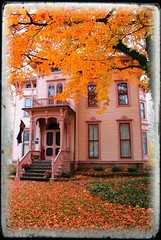
(Picture: CC 2007 by TW Collins)


4 comments:
I was a teenager through the 1970's The House In November and The Scent of new-mown hay were the first Sci Fi books I ever read. Since then I've been a big fan of slightly offbeat Sci Fi.
You mentioned Orson Scott-card, by coincidence i'm currently re reading the Shadow series which I think is better than the Ender series in many ways,
I'll have to check out the Shadow series, Jim. I enjoyed Ender's Game, but didn't love it. It engaged my intellect while leaving my heart cold.
Hi Loren, the rest are more satisfying. Enders Game is a young adult coming of age book that really doesn't belong to the series. The next book "Speaker For The Dead" is set 3000 years later and is less dramatic and far more challenging. in my view OSC will never rank with Asimov or Tolkien but he is great story teller. If you decide to read both series I suggest that you leave a few weeks between each book. otherwise it is easy to miss the unique theme of each book. An interesting sidebar: A teacher friend of mine asked half her pupils to read both series in reverse order and the other half in the order they were written. and then do a book report on Enders Game as a stand along read. the guys who read EG first loved it. The guys that read it last thought it was OK but immature.
Interesting response from those students, because I thought that Ender's Game was slight from my first read. I remember someone I knew in college raving about Speaker for the Dead. Guess I'll have to check it out now! Thanks for the heads up, Jim.
Post a Comment