skip to main |
skip to sidebar
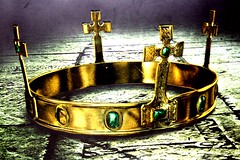
Anyone find it apropos that George R.R. Martin’s initials nearly spell out the tone of his books? As the reigning king of postmodern epic fantasy, GRRM has founded his throne on grimly plotted tales where intricate intrigues meet a willingness to rub out any character, no matter how likable. A tongue-in-cheek bumper sticker sums up his uncompromising approach: “Guns don’t kill people. George R.R. Martin kills people.” Of course, uncompromising really isn’t the right word choice, is it? Perhaps evangelistic would be better, because Martin seems to like to preach to readers that the world is (in the words of Stephen Hunter) “a stainless steel rat trap with a 4,000 pound spring.” That’s part of the reason why I’ve never really gotten into the A Song of Fire and Ice series. Sure, critics like to bring up the fact that the books are modeled after The War of the Roses, but having a historical basis doesn’t necessarily imbue a work’s themes with greater verisimilitude. Betrayal, murder, and rape are no more real than valor, love, and sacrifice. Chinese-American author Ken Liu seems to understand this. His debut novel, The Grace of Kings, is equally committed to both virtue and violently executing figures that readers have come to know and love.
The archipelago of Dara has never been a peaceful place. The six nation-states situated on the big island have squabbled for centuries, their conflicts fanned to a fever pitch by a petty pantheon of eternally squabbling gods. But that was before the arrival of Emperor Mapidéré, a Xana king with a grand vision for unifying the islands through the military might of his fleet of airships. And he succeeds, but the resulting empire has more in common with Hoeryong and Piaskowy than Plato’s mythical republic. An iron-handed centralized government. An impenetrable bureaucracy. Cultural colonialism enacted by royal diktat. Plenty of people have reason to hate Mapidéré—as do the gods themselves. Divine disagreements are about to engulf the entirety of Dara in pitched conflict, and the contest for conquest will come down to two men: Mata Zyndu, a ferocious giant of a man who’s the last heir of his noble clan, and Kni Garu, a small-time gangster whose criminal deeds shroud his surprisingly gracious temperament.
The first thing you’ll find after opening The Grace of Kings is a map—a big map awash with colors and names, everything neatly drawn to scale and put in its proper place. Soon after, you’ll discover a pronunciation guide and then three full pages of major characters. None of these things reassured me. I typically read at night, yawning my way through chapters, and the thought of trying to keep a skein of subplots from getting tangled typically just makes me more tired. But Liu does something rather brilliant: He structures the book as a series of interlocking vignettes with the main characters popping into and out of them from time to time. Make no mistake, The Grace of Kings is a beast of a book, so chock full of detail that only the most obsessive readers will manage to puzzle every piece together. But it’s also remarkably easy to page through a chapter after a long day, a refreshing development in a genre whose tomes too often turn plodding after the first few chapters. I found the book’s themes equally engaging. Not only does Liu give even the most seemingly despicable characters a sympathetic twist, often making them downright heroic in unexpected ways, the proceedings also appear to hint that fiscally restrained, democratic, laissez faire governments best respect the needs of the common man. Less welcome is the idea that infidelity can make for a happy marriage or that Mapidéré might have been justified in forcibly quashing local distinctives. Of course, The Grace of Kings is only the first entry in the series, so Liu has plenty of space to unspool such musings even further. Add in epic fight scenes, magnificent shifts in plot, and the surprising sacrifice of character after character, and Grace is fantasy fit for royalty.
(Picture: CC 2013 by jason train)
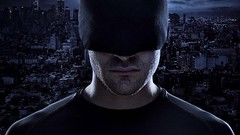
Over the past few weeks, I’ve found myself mulling over Charles Stross’ taxonomy of space opera clichés. (By the way, my apologies, dear readers, for the recent lack of content. Professional pressures and a pregnant wife do not a flexible schedule make.) Now, I wasn’t thinking about his actual suggestions per se. Rather, I found myself mulling over the entire idea that greater verisimilitude makes for a better story—and increasingly disagreeing with it. Why? Well, consider Netflix’s reimagined-superhero drama Daredevil Exhibit A for the prosecution.
For those not familiar with it, this iteration of Daredevil throws grit, grime, and grue onto Stan Lee’s 1964 blind vigilante-cum-lawyer Matt Murdock, amps up the violence to premium-cable levels, and pumps out plots more reminiscent of Justified or Drive than classic Marvel fare. Not that it makes for bad television. Indeed, thanks to Netflix’s commitment to shoving out an entire season’s worth of episodes at once, I found compulsive viewing a real risk. Creator Drew Goddard knows how to twist comic-book conventions just so, transmuting the ridiculous into compelling drama. And my enjoyment of his uber-dark vision wasn’t at all impacted by a number of utterly implausible details.
Allow me to focus in on one eye-roller in particular: guns. Understand that Daredevil takes great pains to remind viewers that it’s set in New York City in general and the neighborhood of Hell’s Kitchen in particular. Murdock regularly references it as the rationale for his decision to practice law during the day and dispense vigilante justice at night. His enemies also view the area as more than a mere staging ground for criminal activity. “I want to make this city, something better than it is, something beautiful,” one baddie intones. Realize, too, that (to quote The Christian Science Monitor) The Big Apple has “perhaps the toughest [gun laws] in the nation, regulating gun sales, ammunition sales, assault weapons, and more.” An op-ed in The Wall Street Journal takes a tougher tone, stating that “New York City's licensing process is almost certainly unconstitutional on a number of grounds, including sheer arbitrariness.” Libertarian journalist John Stossel would likely second that seeing that he made an exposé about his failed attempt to navigate NYC’s labyrinthine bureaucracy and obtain a concealed-carry permit. I don’t bring any of this up to debate the firearm issue, simply to say that you wouldn’t expect a storyteller with a bare-bones commitment to verisimilitude to put pistols in the hands of anyone except the bad guys—right?
Wrong, wrong, wrong. All sorts of (more or less) innocents end up packing heat during the show’s first two seasons. In Episode 1.5 (“World On Fire”), the seemingly nebbish gangster Kingpin punctuates a romantic dinner with an art dealer named Vanessa by asking her why she’s packing. (“May I ask you something now? What kind of gun is that you have in your purse?”) A seedy pawn-shop proprietor in “Dogs to a Gunfight” (2.2) advertises “Guns & Gold Bought & Sold” to a high-caliber assassin bent on vengeance. And “The Man in a Box” (2.10) sees Murdock’s secretary, Karen, yanks a pistol from her dresser to level it at that selfsame hitman.
Here’s the interesting thing, though: While all these examples might falter on the ground of plausibility, they do yeoman’s work in developing both characters and plots, in advancing scenarios and revealing personal peculiarities. When Kingpin calls Vanessa on the carpet for concealed carry, viewers learn that she’s not some ingénue, but rather an empowered woman with her own ambitions: “We’ve been sitting here talking for hours, and you’re going to insult me like I have no idea what you really do? ... I know you’re a dangerous man. That’s why I brought a gun to a dinner date.” By selling “an NYPD tactical communications rig ... that gets encrypted tactical frequencies,” the pawn-shop owner sets in motion most of the events of the show’s second season. And the hitman teases all sorts of interesting implications out of Karen’s preferred choice of firearm, noting that “people who don’t know [expletive] about guns usually go for something shiny, you know, something with a fancy grip. There’s always the [expletive] who gets the big hand cannon that kicks like a mule, and they’re too afraid to use it. But a .380 shows thought. Maybe it’s not your first rodeo.”
Now I’m not trying to suggest that genre authors should completely shun reality out of a desire to adhere to their creative vision. We want to avoid obvious howlers like, say, making a monolithic planetary biome or having Space Nazis With Big Guns take over the moon. But we also shouldn’t ignore the fact that a kind of critical cottage industry has sprung up with entire sites dedicated to cataloguing genre conventions, ranking supposedly overused tropes, or sneaking in politically correct themes under the guise of genre-busting. A moment for a personal pet peeve, if I may: There’s nothing necessarily wrong with including a damsel in distress or having a traditionally masculine hero save her. What matters is what the author chooses to do with it.
Therein lies the rub. Blind critique of conventions often ignores an author’s intent. Maybe a writer is subverting a trope. Maybe he’s employing it in an slippery new way. Maybe his compositional attention is elsewhere and further developing a seemingly stale part would detract from the work as a whole. Any number of factors might be in play. So before we begin to rail about stereotypes, let’s first consider what the writer’s trying to do. Sometimes even ice worlds and Nazi lunar bases can make for engaging stories.
(Picture: CC 2015 by peter lowe)


