skip to main |
skip to sidebar

The sky above the port was the color of television, tuned to a dead channel.
The first time I tried to read Neuromancer, I stopped around page 25.
I was about 15 years old and I’d heard it was a classic, a must-read from 1984. So I picked it up and I plowed through the first chapter, scratching my head the whole time. Then I shoved it onto my bookshelf, where it was quickly forgotten. It was a dense, multilayered read, requiring more effort than a hormone-addled adolescent wanted to give. But a few years later, I pulled the book down and gave it another chance. This time, William Gibson’s dystopic rabbit hole swallowed me whole. Case was twenty-four. At twenty-two, he’d been a cowboy, a rustler, one of the best in the Sprawl. He’d been trained by the best, by McCoy Pauley and Bobby Quine, legends in the biz. He’d operated on an almost permanent adrenaline high, a byproduct of youth and proficiency, jacked into a custom cyberspace deck that projected his disembodied consciousness into the consensual hallucination that was the matrix.
Neuromancer is basically a futuristic crime caper. The main character is Case, a burnt-out hacker, a cyberthief. When the book opens, a disgruntled employer has irrevocably destroyed parts of his nervous system with a mycotoxin, meaning he can’t jack into the matrix, an abstract representation of earth’s computer network. Then he receives a suspiciously sweet offer: A mysterious employer will fix him up if he’ll sign on for a special job. He cautiously agrees and finds himself joined by a schizophrenic ex-Special Forces colonel; a perverse performance artist who wrecks havoc with his holographic imaginings; a long-dead mentor whose personality has been encoded as a ROM construct; and a nubile mercenary with silver lenses implanted over her eyes, retractable razors beneath her fingernails and one heckuva chip on her shoulder. Case soon learns that the target he’s supposed to crack and his employer and are one and the same -- an artificial intelligence named Wintermute. The phone nearest him rang.
Automatically, he picked it up.
“Yeah?”
Faint harmonics, tiny inaudible voices rattling across some orbital link, and then a sound like wind.
A fifty-lirasi coin fell from his hand, bounced, and rolled out of sight across Hilton carpeting.
“Wintermute, Case. It’s time we talk.”
It was a chip voice.
“Don’t you want to talk, Case?”
He hung up.
On his way back to the lobby, his cigarettes forgotten, he had to walk the length of the ranked phones. Each rang in turn, but only once, as he passed.
Unlike most crime thrillers and many works of speculative fiction, Neuromancer is interested in a whole lot more that plot development. Gibson famously coined the word “cyberspace” and he imagines a world where continents are ruled more by corporations and crime syndicates than nations, where cultural trends both ancient and modern dwell side by side, where high-tech and biotech miracles are as ordinary as air. On one page you’ll find a discussion of nerve splicing, on another a description of an open-air market in Istanbul. An African sailor with tribal scars on his face might meet a Japanese corporate drone implanted with microprocessors, the better to measure the mutagen in his bloodstream. When he’s not plumbing the future, Gibson dips into weighty themes such as the nature of love, what drives people toward self-destruction and mind/body dualism. It’s a rich, heady blend. Archipelago.
The islands. Torus, spindle, cluster. Human DNA spreading out from gravity’s steep well like an oilslick.
Call up a graphics display that grossly simplifies the exchange of data in the L-5 archipelago. One segment clicks in as red solid, a massive rectangle dominating your screen.
Freeside. Freeside is many things, not all of them evident to the tourists who shuttle up and down the well. Freeside is brothel and banking nexus, pleasure dome and free port, border town and spa. Freeside is Las Vegas and the hanging gardens of Babylon, an orbital Geneva and home to a family inbred and most carefully refined, the industrial clan of Tessier and Ashpool.
That complexity translates over to the novel’s prose style, which is why I suspect my first effort to read it failed. Gibson peppers his paragraphs with allusions to Asian geography and Rastafarianism, computer programming and corporate finance. He writes about subjects ranging from drug addiction and zero-gravity physics to synesthesia and brutal back-alley violence. And he writes with next to no exposition. You aren’t told that Case grew up in the Sprawl, which is the nickname for the Boston-Atlanta Metropolitan Axis, a concreted strip of the Eastern Seaboard, and that he began training in Miami to become a cowboy, which is slang for a cyberspace hacker, and that he was immensely skilled at it, et cetera, et cetera. No, you’re thrust right into Case’s shoes as he swills rice beer in Japan and pops amphetamines and tries to con the underworld in killing him when his back is turned because he thinks he’ll never work again. You have to piece together the rest on your own.
Challenging? You bet. But it’s electrifying once you get it.
I’ve worked by paperback copy until the spine and cover have split, until the pages have faded like old newsprint. Echoes of its diction sound in my own writing. Thoughts of Chiba City or BAMA pop into my head when I walk through the mall and hear a mélange of voices speaking in Spanish and English and Creole and German. Neuromancer has steeped in me over these years and I can’t imagine what they would be like if I hadn’t pressed on into page 26.
 I first cracked the cover of Asimov’s short-fiction collection I, Robot without much relish. I’ve never enjoyed hard science fiction, a genre whose proponents often seem more interested with the gravitational pull on Mars or the finer points of quantum physics than in crafting an entertaining narrative. Imagine my surprise when I realized I, Robot isn’t SF at all. It’s a collection of mysteries.
From police procedurals to cozies, hardboiled detective stories to whodunits, the mystery genre operates on a central convention: the dilemma. Something is wrong, someone doesn’t know everything about it that he would like and he (and the reader) spend the bulk of the narrative trying to figure it out. It could be the motivation for a character’s strange behavior or an unknown cause of death or the location of a missing perpetrator. No matter the emphasis, though, the pattern of dilemma, investigation and discovery remains constant.
Asimov clings to those conventions like a drowning man to driftwood. He erects three laws to which all robots must hew, introduces an apparently impossible violation and invites the reader to figure it out. (For the uninitiated, the three laws- -in decreasing order of importance- -are that a robot must not directly or indirectly harm a human; a robot must obey humans; and a robot must preserve itself unless doing so conflicts with the other two laws.) One scenario involves a robot becoming convinced he was created by a space station’s power converter and refusing to acknowledge his handlers’ commands. Another finds a mind-reading robot answering questions conflictingly despite being told to tell the truth. In a third, a flippant order from a frustrated technician to “go lose yourself” gets taken in a very literal manner.
I, Robot proudly wears all the trappings of SF. There are positronic brains and deep-space energy storms, asteroid-mining expeditions and interstellar travel. But you get the odd feeling while reading that Dorothy Sayers could’ve written it if only she’d studied biochemistry at university. Some might not enjoy having their genre expectations subverted in such a manner, but to me that was exactly when the fun started.
(Picture: CC 2005 by litmuse)
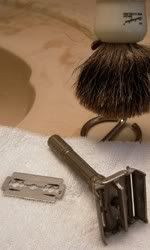
 Writing reminds me of razors.
Background: Like pretty much every guy, I started shaving when puberty grasped me in its hormoned grip, but I always used an electric razor. It was a gift from my parents and a natural choice for me. Coordination wasn't high on my list of virtues; convenience was. Over fifteen years passed with me lawnmowering my stubble. Then two things transpired a little over a year ago to change that.
The first was a Christmas gift from my sister in law--shaving cream. Not just any shaving cream, mind you. This was C.O. Bigelow Premium Shave Cream with Eucalyptis Oil, the kind that comes in a tube and that you whip into a lather with a badger-hair brush. The cream had a pearlescent sheen and smelled of menthol and planted in my mind all sorts of romantic notions that can accompany a flawlessly depilated face. Yet even though my electric left a lot to be desired, coordination and convenience won out in the end. I stuck my tube of Bigelow in a drawer and continued lawnmowering.
The second came during a trip to visit my in-laws. I mentioned to my wife's father and her sister's fiancé, who was also visiting, my dissatisfaction with my trusty Norelco. In addition to being a tad uneven in the closeness department, it had begun spewing clippings about the bathroom. Both urged me to try wetshaving. The fiancé praised his beloved's Bigelow. I asked my father in law what he used. "Water," he intoned in a manner that would've done Dirty Harry proud. "I've got an old can of cream and a Bic in the bathroom. Wanna give it a go?" My masculine pride pricked, I lathered up and dragged the razor across my cheeck.
It was--quite literally--a bloodsport. Crimson runnelled down my chin and throat. The washcloth looked as if someone had used it to clean up a crime scene. Yet the parts I'd managed to avoid slicing were smoother than ever before, and when I went into the kitchen I got a dutiful peck from my wife.
Today I've graduated to a single-blade razor (not to be confused with a straight razor). It's challenging to use. Most days leave me with at least a few nicks, and sometimes I have to go back to the electric to give my skin a rest. There are times, though, when I make it through three passes cleanly, and my face feels like the proverbial baby's rump. Those are the times that keep me picking up the razor.
Writing's the same. Some days character and plot, metaphor and theme, imagery and setting spurt from me like a fire hydrant. Mostly they don't. Some days it feels more like opening a vein. But it's those times of almost effervescent insight that parks me at my pad and make me drag my pen across it.
 I have a bad habit.
I like stories. (That isn't the bad habit. It's coming later.) During a typical week, I’ll read them or watch them or listen to them and then I’ll want to tell someone else about them. The conversation will begin something like, “Hey, I saw Atonement last night,” or “So, I just finished a book by R.A. Lafferty.” The person will then typically ask what I thought about it.
What do I always say? “It was interesting.”
I say it so often that an old writing buddy snorts whenever he hears it. I can’t say that I blame him. After all, “interesting” is value-neutral word. It tells one very little about an individual’s assessment of the thing in question. The Northern Lights can be interesting. So can a seven-car pileup on I-95. Try using the word the next time your wife asks your opinion of her new hairstyle, and you’ll see what I mean.
On the other hand, “interesting” is a superlative complement in our day and age. We are bombarded with more wonders than our ancestors could dream. In olden times, nobles would gather to hear a bard spin his stories. Now the whole life’s work of the bard and many others like him can fit in a device about the size of a deck of cards. Encyclopedias have fallen out of fashion since you can access the breadth of their contents and more with a few taps on a keyboard. Want to learn what happened across the globe today? Take your pick of pretty talking heads, some of which will blather for you twenty four hours a day.
The point of all this is that if something catches your interest, it's special. That’s a tough thing to achieve because we’re a grossly oversaturated society. But learning how to captivate someone, to induce him to willingly give you a parcel of his mental real estate is vital if you want to tell stories. Putting it in slightly different vocabulary in An Experiment in Criticism, C.S. Lewis wrote, “Every good book should be entertaining. A good book will be more; it must not be less. Entertainment … is like a qualifying examination.”
Love what I write? Hate it? Either’s fine, as long as you find it interesting.
(Picture: CC 2006 by nick_russill)
So, you really want to know, huh? Okay, I'll tell you.
I did it. That's right.
I killed my Muse.
You've heard of her. One of a bunch of Greek goddesses who bring artistic inspiration to men. If she happens to traipse around while you're laboring over your work, she might smile and grant you a really killer turn of phrase or a crucial thematic revelation. I used to wait on her a lot, but she was a flighty thing, always flitting off to see all sorts of other fellows. The moments when she showed up were wonderful, truth be told, dizzying times with ideas bursting out of me like water from a hydrant. Then she would invariably leave, and there would be long stretches of nothing, cracked and dry and fallow.
This could have gone on forever, but it didn't. At the end of my senior year of college, I took a creative writing class, and about the time the work really started to pile on I got a call. There was an opening for an entertainment journalist at a magazine in Colorado, and the editors were interested in me--if I could produce some writing samples for them. Sure, I said, no problem, I'll send them next week. I didn't tell them of all the other writing assignments I already had. I went back to my dorm room, booted up my computer and waited for her. The hours turned over with nothing to show for them except a quickly erased sentence or two.
She wasn't going to show. I knew it at some cellular level. She'd left me out to dry.
I looked at the mockingly blank screen and wanted to weep. But instead I bent my head, put my hands to the keyboard and started to type. Gibberish at first, stuff like I'm just moving my hands around with no idea of what I'm doing and Man, I could really go for some waffles right now and There once was a man from Nantucket / Whose head was shaped like a bucket.
Then it changed. Something ... happened.
An outline materialized in my head. Transitions started appearing. I had a kicky closing sentence. It was tough, like digging through a cement wall with a spoon, but it was happening, and my muse was nowhere in sight. I'd done it all myself.
Over the weekend, I wrapped up my projects and began making preparations. You have to understand. She'd led me on all these years, kept me servile and dependent. She had it coming. You can dredge as many canals as you'd like, lead your bloodhounds through the forest. You won't find her. I made sure of that.
Before you make that call and I get all Mirandaed up, let me tell you something. There are eight more Muses out there, convincing others that they need them, that they can't work without them.
You know what you should do.
Oh, one more thing before you go.
Happy New Year ...